
Press releases

GMO potato ‘Amflora’ cannot be used for consumption potatoes and in processed potato products for human consumption.

Brussels, 4 March 2010.

EUPPA, the European potato processing association , has taken notice of the Commission’s decision of 2 March 2010 to authorise – under the current legislative framework  decided by the Council and the European Parliament and after a double scientific safety assessment by Europe’s food safety agency EFSA – the cultivation of the GMO potato Amflora in the EU for industrial use and the use of Amflora's starch by-products as feed.

The usage of this potato variety in the individual member states will depend on the decision by the national authorities to allow the cultivation of this GM crop on their territory.

EUPPA is clarifying that the Commission’s decision to authorise the cultivation of this GMO potato variety owned by BASF, which is referring to the ‘industrial usage’ of the potato, includes the exclusive usage of this potato in the starch potato industry and this only for non food applications (e.g. paper industry).

This means in practise that this decision excludes the usage of this GMO potato variety in the production of consumption potatoes grown by EU producers, or potato products produced by EU companies processing potatoes for human consumption.

The European potato processing industry is confirming through its industry association EUPPA ,that its companies will respect this legal requirement in their production processes.


European Potato Processors’ Association launches new name EUPPA at a European Parliament event in Brussels

EUPPA, the European Potato Processors’ Association, is the new name of the former UEITP (Union européenne des industries de transformation de pommes de terre), as its president Kees Meijer stated during a meeting today with members of the European Parliament and staff members of the European Commission in the buildings of the European Parliament in Brussels.

Although the European potato processing industry is a rather young sector in the food industry, the European association has already been created in 1962. Since then the sector had developed in a spectacular way to a world player with about 12 million tonnes of potatoes (20 % of the total EU crop) being processed to frites, crisps, croquettes, flakes, mashed, and other potato products. More than 25.000 employees have found a job in this industry.

550.000 tonnes of finished product is being exported all over the world. On world level the major exporters are The Netherlands, Canada, Belgium and the United States. However the sector has also a rich tradition of marketing a wide variety of potato specialities in the various EU member states.

It was no coincidence that the first EUPPA event took place under the title ‘bringing tradition on today’s plate, all over the world’.

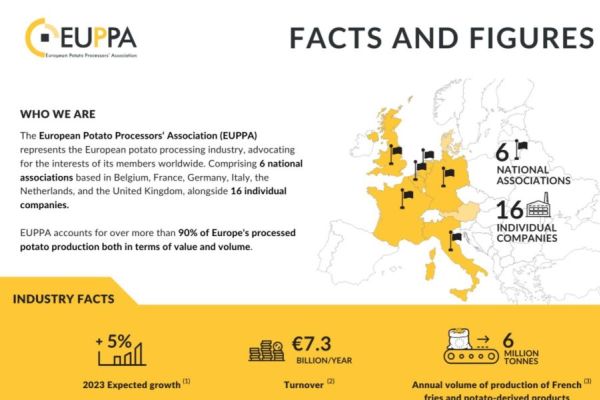
EUPPA represents the potato processors of the ‘big five’ potato producers in the EU (Belgium, France, Germany, the Netherlands and United Kingdom), but also of Austria, Italy, Poland and Sweden and is a member of the CIAA, Europe’s food industry association.

According to Kees Meijer the potato consumption is facing a promising future as he referred to the UN international year of the potato in 2008, when the possibilities of the humble potato as a major staple food to feed the world has been illustrated. China and India have become the major fresh potato producing countries in the world, which is probably rather surprising. The EUPPA president sees a specific role for the processing industry in this development.

Challenges for the potato processing industry :

During his presentation he also focused on a number challenges which the sector is facing, in which he hopes that the European Parliament and the Commission will also take the role of the potato processing industry into consideration.

Although the potato crop IS one of the few agricultural products which is not organised by a European market regime, Kees Meijer fears that the revision of the European agricultural policy in 2013 could neglect the specific role of this sector. Europe is highly competitive on the world market with its potato production – without any support or intervention – and EUPPA invites the European policy makers to take this into account when new proposals are being worked out. He referred also to the changes in the sugar regime which have affected the balance in the crop rotation of European arable farmers. The impact analysis carried out by the Commission did not consider the effect on the potato markets.

The EUPPA president also referred to a number of measures in the framework of the EU quality policy for agricultural products to illustrate that they might increase the cost of the European potato products : he questioned the added value of mentioning the origin of the raw potatoes on a bag of potato products, knowing that the production area of the EU is concentrated in at least 4 or 5 member states ?

On the other hand the European potato processing industry has provided an answer to the health questions asked by the Commission and Parliament : the use of liquid (healthier) oils in the food service has resulted in a positive effect on trans fat reduction. The industry has introduced new and healthier potato products on the market at a high speed. Oven fries, precooked fresh and half prepared products and mashed potatoes are some examples where nutrition, convenience and health have met.

This issue brought Kees Meijer to the current discussions on the labelling of nutrient and nutrition values on the food products. He asked for more clarity and legal certainty regarding the labelling of certain processing aids. After years of discussion it is still not clear whether the labelling of the use of pyrophosphate (to stabilise the colour of the products) is obligatory or not !

He also invited to consider the question of the potato, fruit and vegetable sector (at least for a number of products) to be able to communicate the nutrient benefits of the product to the consumers without to pass a long and expensive procedure via EFSA.

One of the major issues affecting the image of the processed potato products is the appearance of acrylamide when heating of a number of starchy food stuffs. Although this issue affects also other food sectors, the potato processors have tackled this problem in a proactive way. The sector has worked out – together with CIAA and the scientific world – a specific tool box to reduce the acrylamide content in its products. This toolbox has become the reference also on the Commission’s website. The outcome of a recent study carried out by the Ghent University on the effect of using a number of additives during the process will be presented at a seminar on 17 March in Ghent.

The EUPPA president also mentioned the participation of the potato processing industry in the current revision of the European plant health regime and the sustainable consumption and production, referring to the ambitious European SCP round table.

Finally he also positively answered to the invitation of the Commission to provide transparency in the prices in the food supply chain. He concluded by the fact that the potato processing industry has become a global industry, without any interventions or subsidies, with the market as the most important driver. He hoped that the policy makers would enable this sector to continue its further development in the same way. Kees Meijer stated finally that the new EUPPA also wants to take up the challenge to increase the communication and collaboration with the Parliament and the Commission.

More information : EUPPA, Romain Cools, e-mail : euppa@fvphouse.be , tel. +32 9 339.12.52, mobile: +32 475/32.87.57